Showing posts with label wood. Show all posts

16 April 2018

Clothespin Star of David ornament

Wooden clothespin star of David 
ornament with copper.
What You Need:
Wood Clothespins
Paint (I used wood paint)
Copper wire
Sand paper
Wood glue

You will need 18 clothespins for a star. Start by taking the clothespins apart and sitting the clothespin springs aside. Sand paper the clothespins and then glue 2 pieces together at a time. Hold the pieces together for a few seconds while the glue dries. You could easily paint them with a sponge brush. Once the paint is dry,glue all the clothespins together to form a six point star, starting glueing from the cemtral ones.
Once the glue has dried, more or less 24h, insert the copper wire.
 

03 April 2018

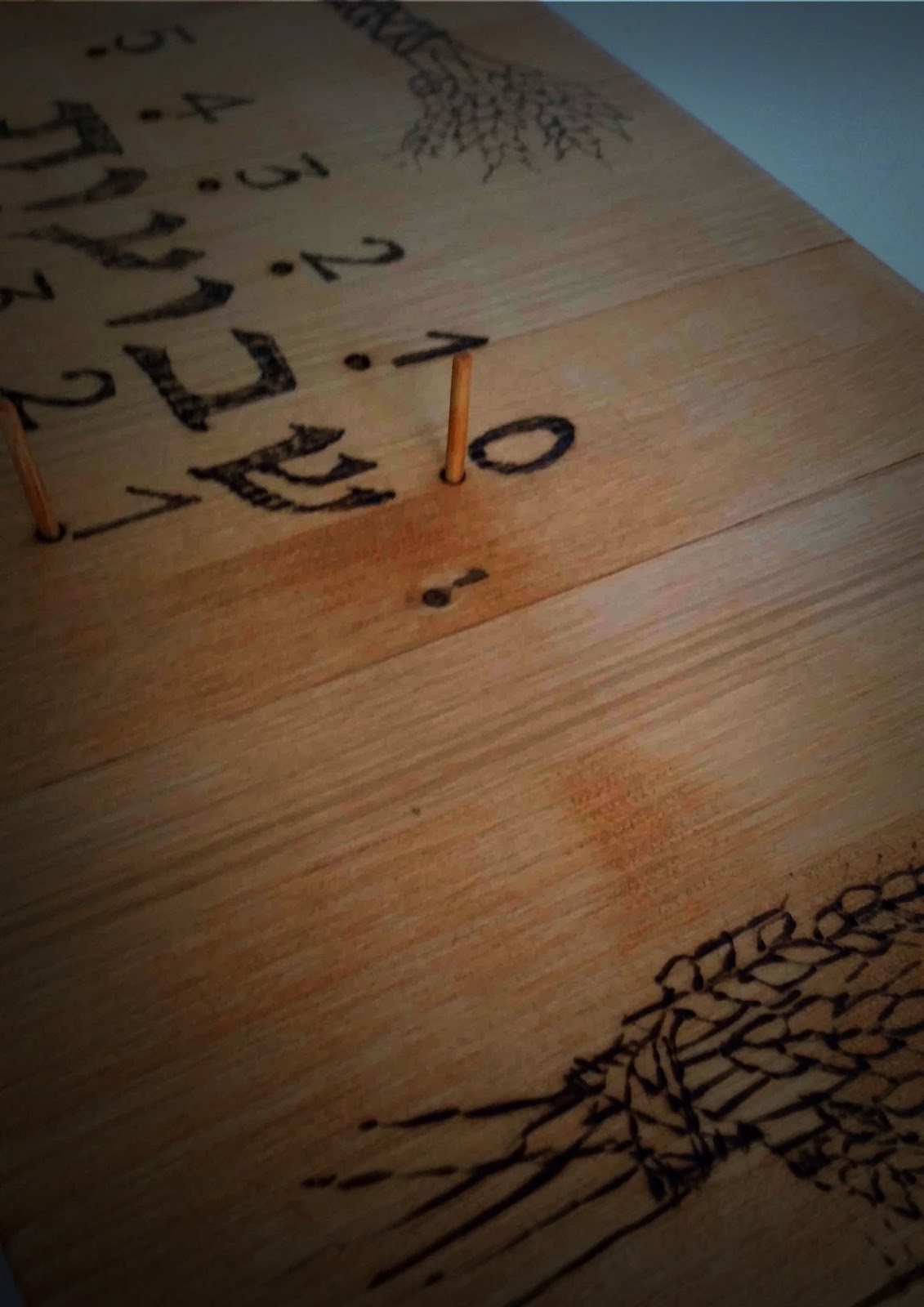
Wooden Omer Counter

The special period between Passover and Shavuot is called sefira, meaning “counting.” The name is derived from the practice of counting the omer, which is observed from the night of the second of Passover until the eve of . The counting of seven weeks from the 16th day of (i.e., the second day of Passover), on which the omer offering of the new barley crop was brought to the Temple, until Shavuot, serves to connect the anniversary of the exodus from Egypt with the festival that commemorates the giving of the on Mount Sinai.
Why the Counting? Tradition has it that it was announced to the Israelites in Egypt that the Torah would be given to them 50 days after the exodus. As soon as they were liberated, they were so eager for the arrival of the promised day that they began to count the days, saying each time, “Now we have one day less to wait for the giving of the Torah.”
Thus, it is explained, the Torah prescribes that the days from Passover to Shavuot are to be counted, symbolizing the eagerness with which the Torah was received by the Israelites. In a similar vein, Maimonides points out that the counting of the omer between the anniversary of the liberation from Egypt and the anniversary of the Torah gift is suggestive of one who expects his or her most intimate friend on a certain day. That person counts the days, and even the hours.
Lag B’Omer is the 33rd day of the counting of the omer, which falls on the 18th of the Hebrew month of Iyar. This day is observed as a semi-holiday.


Handmade Wooden Omer Counter


A compact and simple Wooden Omer Counter helps you to keep track of the days and weeks, you just move the pins as you recite the words.  


49 Days Of Omer Counting In Pictures


28 February 2018

Wooden Ratchet Noise Maker for Purim

When the Purim story ("Meglliah") is read, everyone boos and shakes their graggers whenever Haman's name is mentioned.
Wood DIY  Purim gragger
Here is a wooden ratchet noisemaker we made, also known as a "gragger" when used during the Jewish holiday of Purim. For this one, I used a few scrap pieces of 3/4 inch thick pine, a 1/2 inch wood dowel (less than 6 inches worth), a piece of 1 1/4 inch dowel for the handle (about 5 inches long), and some 3/16 inch dowel for the wooden pegs. 
With everything assembled, you can give it a spin and see how it works. 
Our noisemaker is fairly loud, and it spins freely in either direction. Have fun! 

05 February 2018

Star of David wood pendant

The Star of David is a symbol commonly associated with Judaism and the Jewish People. In Hebrew, it is called Magen David (“Shield of David”). A six-pointed star, the Star of David is composed of two overlaid equilateral triangles, one pointing up and the other pointing down.
Two Triangles in the Star of David
The Zohar (3:73a) states, “There are three knots connecting [three entities] one to another: the Holy One, blessed be He; Torah; and Israel.” The Jewish soul connects to its Creator through the study and observance of Torah. The triangle represents the connection between these three entities. The essence of the soul connects with G‑d’s essence through the study of the teachings of Kabbalah


Star or Shield of David handmade pendant carved from solid pine wood and naturaly wax finished.
Wood Pendant

The Magen David: How the Six-Poined Star Became an Emblem for the Jewish People


24 January 2018

Decorative handmade trees for Tu b'Shevat

The celebration of Tu B'Shevat  is the New Year of Trees which is one of the four New Years referenced in the Mishnah or Mishna. This is a minor Jewish Holiday in modern times serving as a tree planting festival and celebration. The holiday is believed to have originated as an agricultural festival indicating the onset of Spring and the fiscal new year of agriculture.
The Hebrew spelling of Tu B'Shevat is ט״ו בשבט‎. This holiday occurs each year in the month of Shevat on the 15th day. Tu B'Shevat is known as the New Year of Trees, Rosh HaShanah La'llanot (ראש השנה לאילנות). Each year on Tu B'Shevat Israelis and Jews across the globe plant trees to celebrate, along with commemorate and honor loved ones on this Jewish Arbor Day.
Decor your home with handmade trees.
Decorative trees

Tu B'shevat - Coloring Book For Adults - Jewish 'New Year for Trees' Festival: Tu B'Shevat Colouring Collection For Teenagers & Grown ups

Trees, Earth, and Torah: A Tu B'Shevat Anthology


03 January 2018

Traditional string and nails art

One-of-a-kind home decor wall art that you make yourself. Keep it or gift it... either way you'll be happy with this unique star string art for your home.
Wood pine board is hand sanded and hand stained in dark walnut, afterward finished with natural wax.  Use the highest quality wool string 
Art of the string


DIY String Art: 24 Designs to Create and Hang


Hanging decorations

Wooden hanging star decorations

Wooden menorahs

If you’re a craftsperson, you’ll definitely appreciate these handmade Menorahs.
Hanukkah is all about spreading the Hanukkah lights publically. These Menorahs are perfect (and quite literal) examples of that.
The upcoming wood Menorahs are a great to draw some creative inspiration.
 Wooden Hand Painted Hanukkah Menorah
These Menorahs are proof that wood Menorahs don’t have to be dull. In fact, with the right dose of Jewish creativity, they become quite the opposite.
I hope you found some inspiration, or perhaps your next wooden Hanukkah Menorah…
Hanukkah Sameach .
 

29 November 2017

Rosh chodesh moon phases

The Jewish calendar is rooted in the cycles of the moon. Each month of the year is a lunar month, beginning on the new moon and ending when the moon is dark. Jews celebrate the first day of the month, the new moon or Rosh Chodesh, as a minor holiday. Sometime during the first two weeks of the month, often at the end of the Sabbath, Jews recite a blessing over the moon in gratitude for having been given the cycles of time. In the last week of the month, on the morning of the Sabbath, Jews announce the name and date of the coming month both as a welcome and a reminder to the community. This announcement signals that the current month is coming to a close. Some Jewish traditions refer to the last day of the month, the dark of the moon, as Yom Kippur Katan (a little day of atonement), and regard it as a day of fasting and penitence. Then the new moon of the next month begins. When the moon dies we contemplate our own mortality, and at the birth of the moon we celebrate our potential for rebirth.
One of the words for "moon" or “month” is chodesh, renewal. The traditional Jewish blessing over the waxing moon says to the moon: “You are a crown of glory for those who are borne in the womb, for they, like you, are destined to be renewed.” Jewish tradition sees the cycles of the moon as a metaphor for the renewal of life.


Jewish Cycles of the Moon on wood


The Laws & Customs of Rosh Chodesh

09 September 2017

Wood Decorative Apple for Rosh haShanà

Apples and honey: For Ash­kenazic Jews, these words are an inseparable pairing. We dip a slice of apple in honey to express our hopes for a sweet and fruitful year.
Why were apples and honey chosen for this custom?
It’s not because of what Adam and Eve did in eating from the Tree of Knowledge in the Garden of Eden; the Bible never identifies the forbidden fruit. More likely, apples were selected because in ancient times they became a symbol of the Jewish people in relationship to G.d. In Song of Songs, we read, “As the apple is rare and unique among the trees of the forest, so is my beloved amongst the maidens of the world.” In medieval times apples were considered so special that individuals would use a sharp utensil or their nails to hand-carve their personal hopes and prayers into the apple skins before they were eaten.
Neither the Bible nor the Talmud dictates the minhag, or custom, of dipping apples in honey. Traditionally, as early as the 7th century, it was customary to wish someone, “Shana Tova Umetukah” (A Good and Sweet Year), and honey ,whether from dates, figs, or apiaries , being the most prevalent sweetener in the Jewish world, was the most available “sweet” for dipping purposes. And as for the biblical description of Israel as a land flowing with “milk and honey,” the Torah is alluding to a paste made from overripe dates, not honey from beehives.

May your year be sweet, fruitful, and filled with contentment and promise.


WOOD DECORATIVE APPLE
 An apple turned from holly wood. It's a pretty simple project for the home Rosh ha Shanà decor in between simple, easy and creative projects.
Making decorations for your home doesn’t need to be difficult, take up a lot of your time or money. Many times the best decorations are the ones you find right under your nose, or behind the garage. That’s where this Wooden Apple started.
The woodscrew chuck is a most useful piece of equipment and can be used to good effect to make wooden fruit.
We prefer the stalks of both apple and pear to leave the fruit at an angle, and this factor influences the chucking techniques. This method means that slightly longer stock than normal is required, but I am quite happy to waste a little wood to make the fruit more natural-looking.
Choice of wood
Exotic hardwoods can produce stunning grain patterns, but  the cost of such species can be prohibitive, particularly in the early learning stage, when mistakes are not unusual. Native hedgerow and garden trees or shrubs can also produce dramatic grain. Yew wood,pine, cherry and holly are eminently suitable, as are spalted woods, particularly beech.

photos from "Woodcraft"
Making Wooden Fruit
Method
Taking light cuts with the roughing-out gouge, reduce the stock to the suggested 70mm diameter. The profiling can now commence at the open end (the stalk end), using a 10mm spindle gouge. A rolling action is required to form the rounded-over section, merging into a swinging, scooping action to form the undercut profile. At a distance of 70mm from the open end, size in with a parting tool to a diameter of approximately 19mm. The remainder of the profiling down to the depth of the sizing cut can now be completed with the same tool. Before reverse-chucking it is necessary to sand and polish the completed section, and also to drill the 3mm hole to accommodate the stalk.


Koren Sacks Rosh HaShana Mahzor UK Edition: Standard Size by Jonathan Sacks (2011-08-11)

24 August 2017

Wooden Star of David - Chodesh Tov Elul

Beginning of new Hebrew month of Elul. Elul is the 6th month of the Hebrew year. Corresponds to August or September on the Gregorian calendar.
Rosh Chodesh Elul begins at sundown on Mon, 21 August 2017.
Elul is the 12th and final month in the Jewish calendar. It is a month that connects the past year with the coming year, a time when we reflect on where we stand and where we should be going.
It is called “the month of repentance” and “the month of forgiveness.” 

On Rosh Chodesh Elul, Moshè ascended to Mount Sinai for a third 40-day period until Yom Kippur, when he descended with the second tablets (luchot) and G‑d’s word of joyful, wholehearted forgiveness. These were days when G‑d revealed to the Jewish people great mercy. Since then, this time has been designated as a time of mercy and forgiveness, an opportune time for teshuvah, repentance.
The four letters of the name Elul are an acronym for the phrase in “Song of Songs” (6:3): “I am to my beloved and my beloved is to me.” “I am to my beloved”we approach G‑d with a desire to return and connect. “And my beloved is to me”G‑d reciprocates with Divine expressions of mercy and forgiveness.
This is the month when “the King is in the field.”

This star puzzle styled is made from Alps pine wood. Pine wood is very soft and easily handcrafted. Handmade working with inspiration.
Make a template by cutting two 5-by-5-by-5-cms triangles out of paper,any paper will do. Turn one triangle upside down, tape it on top of the other one to create a six-pointed star, and outline the star on poster board. Or simply download and print out the template here. You can also have a copy to enlarge or shrink it to three different sizes so that you can see which one looks best on you. Use your final choice to make a wood star by cutting 12 triangles and then glueing them together.


WOOD AND WOOL STAR OF DAVID


These are custom, hand cut, 6 point stars made of white pine with carded wood added in the centre, in sets of 4 different colours. Each star may vary slightly in size or woool colours. They are  sanded to clean up the edges and finished with water wood paint.
Your Jewish guide - Elul Tishrei: A Comprehensive, Contemporary Guide to Jewish Life. Everything you ever wanted to know about The Month of Elul and the Holidays of Tishrei.

Working Wood 1 & 2: the Artisan Course with Paul Sellers
Please contact me if you want to place an order for the stars.


07 April 2017

Kids friendly Passover centerpiece kit

The Seder plate is the focal point of the proceedings on the first (two) night(s) of Passover. Whether it is an ornate silver dish or a humble napkin, it bears the ceremonial foods around which the Seder is based: matzah, the zeroa (shankbone), egg, bitter herbs, charoset paste and karpas vegetable.
Kids friendly Passover centerpiece kit

Wooden Seder Styled Plagues and Matzot Decorative Holder
Handmade wooden table with Seder cerimonial foods, decorative matzot jewish signs and the ten plagues.

Though many Passover hosts and hostesses feel enslaved by intense holiday preparations, here's how you can create a nice and kids friendly Passover centerpieces with ease.
When the Passover table is crammed with wine bottles, glasses, seder plates and boxes of matzo, finding the right centerpiece can be tricky.
If you want to add flowers think about using topiaries because they provide height without obstructing the view, they do not die so you can start with white roses in the arrangement for the seders and switch to lemons or strawberries for the end of the holiday.
For large tables, scattering clusters of flowers in bud vases add color without the bulkiness (or expense!) of a formal arrangement.
Opt for vibrant colored tablecloths with patterned textures and choose simple flowers within variations of two colors that contrast with the tablecloth. As long as the flowers are in the color scheme, inexpensive ones will do the trick.


Look for some disposable plastic plates Passover Seder dishes, ideal for children for Passover if you're in a hurry and want to decor your table on a budget.


Passover (Door with Blood ), Pesach ornament idea

All entryways were daubed with blood. The people of Israel were about to be birthed into a new people, a free people, no longer slaves of others. It would be a long infancy – once birth was assured.
Exodus tells of Blood on the doors
"They shall take some of the blood and put it on the two doorposts and the lintel of the houses in which they eat it. They shall eat the lamb that same night; they shall eat it roasted over the fire with unleavened bread and bitter herbs. (...) It is the passover of the Lord. For I will pass through the land of Egypt that night, and I will strike down every firstborn in the land of Egypt, both human beings and animals; on all the gods of Egypt I will execute judgments: I am the Lord. The blood shall be a sign for you on the houses where you live: when I see the blood, I will pass over you, and no plague shall destroy you when I strike the land of Egypt.

Passover (Door with Blood ), Pesach ornament idea.
Handmade small wood door with felt blood on jambs.

Shabbat Hagadol
The Shabbat which precedes Passover is called Shabbat haGadol, the Great Sabbath, for many and varied reason

The Torah commanded them to take their lambs and tie them to the bedpost. When they did so, their Egyptian neighbors saw this and asked:
"What is the lamb for?"
The Children of Israel answered: "It is to be slaughtered as a Passover sacrifice as G‑d has commanded us."


If don't have time to search for a reclaimed piece of wood and work on it, look for unfinished pieces of wood doors . Then paint it and apply felt as blood.


06 January 2017

Decorative Star shap wood box

Decorative hand painted fancy small wood gift box Star of David shape.
A perfect Hannukah small gift...

01 October 2016

Felt beehive for wood bees

Rosh HaShanah (ראש השנה) is the Jewish New Year. Over the centuries it has become associated with many food customs, for instance, eating sweet food to symbolize our hopes for a "Sweet New Year."
Biblical texts often mention "honey" as the sweetener of choice though some historians believe that the honey referenced in the Bible was actually a sort of fruit paste. Real honey was, of course, available but much more difficult to acquire! Honey represented good living and wealth. The Land of Israel is often called the land of "milk and honey" in the Bible.


Rosh haShanà felt decoration for a sweet new year

Honey Cake

19 October 2015

Homemade geoboard

The Geoboard is a tool for exploring a variety of mathematical topics introduced in the elementary and middle grades. Learners stretch bands around pegs to form line segments and polygons 
Geoboards offer opportunities for hands-on exploration of geometric concepts, including shapes, symmetry, congruency, area, perimeter, coordinates and spatial relationships.
An homemade geoboard is quite simple ti do. Take a wooden cutting board and some nails. Paint your cutting board and plant the nails following the geometric pattern that you have drawn first on the chopping board. Put rubber bands ...and play
Try a virtual geoboard here

27 August 2015

Summer break - mountain wood art crafting

The craftsmanship typical of the Alps has its roots in the rural culture of the Alps. The traditional way of life of mountain people involved for each of being both a farmer and rancher, in order to make the most of the limited resources of a territory avaricious, and to become in case of need also craftsman, as the city markets were distant and high prices in relation to the limited financial resources. From here the need to produce in their own home, as far as possible, the tools necessary for the work of the fields and home use.Countless generations of farmers-craftsmen so elaborate, through the centuries, various techniques to make the most of certain agricultural and livestock products: hemp, wool and leather, and to make better use of raw materials that nature offered in large quantities: the wood and stone.
The industry, being the tools of necessities now imported and mechanized agriculture, have been able to diversify in recent decades, to a craft art whose creations are continuing to diversify and refine.


Related Posts Plugin for WordPress, Blogger...